Showing posts with label Social Media. Show all posts

Thursday, June 13, 2013

Why my mother's absence from Facebook should concern you

Let's backtrack and talk demographics for a moment. Let's take a look at Ar...Jenny. She
  • is college educated and has a master's degree
  • is upper-class
  • actively volunteers in the community, including mission trips to Africa where she helps children infected with HIV
  • travels to exotic destinations like New Zealand (where she enjoys hiking up to 17 miles a day) or Costa Rica (where she enjoys zip-lining in the jungle)
  • drives a Prius
  • owns an iPhone
  • reads books on her iPad (and is completely addicted to online Scrabble)
  • shops online
You're probably thinking that Jenny must be your typical social media savvy consumer. She is the ideal person you want to reach through Facebook, Twitter, YouTube, Pinterest, Instagram, LinkedIn and other social media outlets. If you were thinking this, you'd be wrong. Jenny is my mother, and she will never use Facebook.

My mother's name isn't Jenny, but all the rest is true. My mother is 72, bright, and incredibly active -- she's even with-it when it comes to some technological advances in this century.

"Jenny" won't be found on Facebook, Twitter or other social networking sites. While she enjoys and uses some Internet-based technologies, she doesn't like appreciate social interaction online. She prefers her communication face-to-face and is too busy with all she has going on to spend much time sitting behind a computer. While demographics are helpful, they can also be misleading when you've used them to make assumptions about your customers like my mother.

There's also another interesting thing about "Jenny." She reads newspapers. She tears out coupons and sets aside any additional offers she finds in the mail. Whenever I visit, she's frantically rummaging around on the counter asking me if I need the latest coupon to Kohl's, Stein Mart or Bed, Bath and Beyond.

It's been tempting for companies to replace traditional advertising and marketing with forms of social media, as they are much more cost-effective. Social media will reach additional people and reach your customers in new and engaging ways. More exposure never hurts. However, if your boss or your client is suggesting that social media is the new marketing going forward, please tell them about "Jenny." Those of us who use social media channels on a daily basis often make the mistake of presuming everyone else shares our same habits.

My mother will never be reached via Facebook, Twitter or Pinterest, but feel free to reach out to her five (broke) teenage and young adult grandkids through social media. If you want to reach "Jenny," a demographically perfect consumer with her comfortable retirement nest egg at her disposal, you're still going to have to use traditional marketing and advertising in print.


Monday, May 20, 2013

Social media...the new town chamber mixer event?

Well, of course it is!

Just when I was beginning to feel guilty for the excess time spent drinking coffee while still in my pajamas, I read something that really caught my eye and profoundly changed my perspective on my seemingly non-productive mornings.

I came across a comment where someone asserted that time spent on facebook, twitter, blog sites, and other social media has become even more important than traditional networking events, like your chamber of commerce mixer. Thank God! Now, many professionals in their 20s, probably don't know anything other than social networking. However, many of us are breathing a sigh of relief that we'll never have to show up as a newbie at a chamber meeting and play an embarrassing game designed to get to know one another with Post-it notes on our foreheads.

While social media is not quite as daunting as the in-person mixer events, it also poses more challenges in that an "online" relationship involves "following" people and being "followed" by others through twitter and blogs. On LinkedIn it's about making "connections," and on Facebook, it's all about your "friends." It takes longer to establish these relationships through reciprocation of making comments to various posts and tweets. My guess is that the old-fashion face-to-face networking led to stronger and more meaningful relationships in the long-run, but social media is here to stay.
Civilized networking...BYOB
(bring your own bunnyslippers)

Pull out your bunny slippers, pour some more coffee and embrace the new attitude that you're not just mindlessly surfing the net, you're NETWORKING! You're being productive and doing necessary things to further your career and build your social worth to the world!

More coffee, please.

Friday, July 27, 2012

Virgins wanted. Who's next at social media's sacrificial altar?

The wonderful thing about communication is that there's always fresh content to discuss. Take for example two cases where companies found themselves at social media's sacrificial altar this past week: Celeb Boutique and Chick-fil-A. Social media is a game changer for companies. Never before have companies been able to have such a direct and immediate dialog with their customers. Never before have companies been able to communicate in this "in the moment" kind of way.

This is both good and bad. While companies can reach audiences in the fifteen seconds it takes to compose a status update or tweet, consumers also have this same power. In the social media arena, this often gives consumers the upper hand. In this new world, consumers can love you one day and crucify you the next. Corporate executives beware.

The first example comes from Celeb Boutique and their ridiculously poorly timed tweet promoting their Aurora dress. Until a week ago, most people didn't have the Colorado town or the trendy dress on their radar. What transpired across social media is a lesson about how not to make your grand entrance.
  
The morning following last week's horrific shooting in Aurora, "clearly" Aurora was trending on Twitter (among the grown-ups). An employee at Celeb Boutique saw the Twitter trend and couldn't contain her excitement as she fired off her less than 140-character tweet. Celeb Boutique featured a Kim-K inspired dress called the Aurora, so the social media employee mistakenly assumed all the buzz around the world was about their $157 white Aurora dress (that's like totally newsworthy, right?). This, folks, is all it takes to make you the laughing stock of Twitter, Facebook and every other social media outlet. Celeb Boutique soon realized their humongous gaffe and issued an apology, coupled with a convenient excuse for their sheer stupidity. Apparently, their communication was handled abroad and they weren't aware of our news due to the time difference. I'm not sure if blaming the Europeans or the Prime Meridian are valid excuses, but if your clients include Kim K. and other celeb wannabes, I don't suppose it matters much.
Lessons:
  1. Always a good idea to look before you tweet.
  2. Sometimes it's actually beneficial to have an adult in charge of social media.
Next topic example comes from Chick-fil-A. Once again, they've fumbled with their anti-gay rights stance. This time, the controversy ignited when President Dan Cathy commented that he is “guilty as charged" of defining marriage as the union of a man and a woman. Cathy's mistake is in not understanding how this proclamation carries the weight of a $4 billion-dollar Goliath when he continues to express it on a public platform.
Cathy's statement caused Jim Henson Co. to back out of a partnership with the chain to make toys for kids' meals. Jim Henson Co. went further by running a full-page ad featuring the Muppets with a statement of their own: as a group embracing diversity, they would not do business with someone they perceived to be discriminatory. Despite a public apology and some backpedaling, the misstep has not gone away. Chick-fil-A's own Facebook page has been a hotbed of controversy as their critics have swarmed their page with hostile posts. The company's Facebook page continues to serve as a battleground for the gay marriage debate, as Chick-fil-A's similarly principled chicken-loving fans have come out in mass to defend the company's position.

It's unclear whether Chick-fil-A can keep alienating so many with this issue. It seems their sales are actually up (and if you believe their loyal Facebook fans, the chains are packing in record crowds during lunch this week). However, this just tells me that right-wing Christians enjoy chicken and will consume large quantities to show loyalty and prove their moral ground. Once this immediate call to eat more chikin subsides, I suspect Chick-fil-A's numbers will dip if they continue to confuse their agenda against gay marriage with the sale of tasty waffle fries. I suppose the Facebook banner advertisement announcing the peach milkshake is back will distract the angry mob somewhat until the dust settles on this one.

 Lessons:
  1. If you want to drag religion and politics into the sale of fast food, pray that your side will eat more "chikin'" than the other side.
  2. Peach? It's no Shamrock Shake. Seriously.

Thursday, July 26, 2012

Martha, is that really you tweeting? Emerging issue of ethics and the practice of ghost tweeting

I recently came across a thought provoking discussion about the practice of ghost tweeting. If you have no idea what I'm talking about, the practice occurs when a communications professional (either agency or internal employee) is tasked to write for social media outlets, but does so in the name of a higher-up (typically the CEO) who is too busy to be tweeting).

When a company creates a Twitter account in the company's name and attaches it to a corporate image or logo, we assume the Tweets are coming from the corporate communications office and represent the "voice" of the company. With the growing popularity of Twitter, many executives and CEOs feel they need to establish Twitter voices of their own. Sometimes they're Twitter-proficient enough to take on this task alone, while other times it's outsourced. The discussion of whether it's ethical for CEOs to create Twitter accounts where someone is posting on their behalf keeps cropping up on industry discussion boards.

My first thought was that it was not a big deal. Was this any different than how marketing has operated for the last century? When I receive a letter promoting the benefits of cable tv, signed by the CEO of Time Warner, I don't really think he wrote or signed the letter personally. I know it's coming from a marketing department on his behalf. I sort of assumed the same thing of high-level business professionals on Twitter; they probably were too busy with all the meetings regarding government bailouts and inflated stock prices important stuff to be tweeting. However, tweeting, unlike direct mail, involves more of a fluid conversation or dialog. Looking at it from this angle, assuming someone's identity on Twitter becomes a different beast. I believe it does inolve some degree of fraud (at least on ethical grounds).
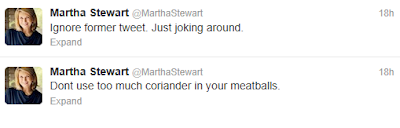
I decided to at look a few high-profile people on Twitter to see how it's handled. I follow Martha Stewart because...well....who doesn't aspire to be more like her?

When I pulled up her profile, there was no disclaimer stating that the tweets were coming from Martha Stewart Enterprises, rather than Martha. Looking at her tweets (many of them were from places where I'd envision Martha tweeting from...like dressing rooms or her chicken coup), it seemed believable that these were her own. I knew with 99.99% certainty this was Martha from the above tweets about not putting too much coriander in your meatballs. Only Martha can joke about meatballs....or coriander. If a social media intern tweeted casual jokes about coriander and meatballs using Martha's name, she'd be out on her ass (chestnut brown pashmina scarf and all).

For the next example, I looked at the highest office out there. Nobody would expect Barack Obama to be composing his own tweets from the Oval Office. I think he'd probably get a lot of backlash if he were tweeting all day instead of attending to corporate bailouts important stuff.


So, how does President Obama have a Twitter presence without tweeting himself? His account openly states that it is run by the #Obama2012 campaign staff and that any personal tweets would be signed by -bo. Michelle's profile is the same, her personal tweets would be signed by -mo.

I've covered the cases of people posting as themselves and people having others post on their behalf (with full disclosure). What happens when a CEO or executive wants both the presence on Twitter and the "appearance" that he's posting himself (making himself look hip with technology), when he is actually using someone on staff to post on his behalf? Is this an ethical area? Is it different than the direct mail letter with his signature that he never wrote or signed? Does the continued dialog or conversation aspect of tweeting make this a type of fraud?

These are questions we don't have answers for in this new and emerging field. As a communications professional, I would always advise to be honest and open about who is posting. Creating profiles where people are misled to believe the CEO is posting is a dangerous game. Who's to say your social media intern hasn't had a drink or two at lunch, and starts posting about coriander meatballs crazy stuff. It's a lot easier to explain and recover if the account clearly stated it wasn't necessarily the CEO tweeting.

You could try the old "my account was hacked" line, but it didn't work so well for Senator Weiner. Complete honesty and disclosure about who is tweeting behind the account is always the best policy.

Is anyone else upset about the coriander meatballs being a joke? Those sounded good, Martha.


Monday, July 9, 2012

What's the coolest, trendiest thing in communications?

This question was recently posed on a LinkedIn group. A member was asked this question on a job interview and wanted to know how others would answer.

Some answers from the group included: Pinterest as a marketing tool, content marketing, brand journalism, interactive communications (all valid trends). I recently read a blog suggesting all communications professionals go on a "press release diet" for six months or more, arguing that press release content could easily and effectively be distributed via twitter, blogging, YouTube videos and LinkedIn. The writer suggested we've come so far with all this cutting-edge technology that the press release was now out-dated and no longer an efficient communications tool.

He got slammed (in a polite way). Several communicators jumped in and argued that the press release was still an essential tool. Think smaller town communities and newspapers (many of which are not online). Communicators need to be targeting the least common denominator in their audience, instead of using the "trendiest" communication tools at the expense of missing most of their audience.

Mistake number one among some communications professionals is that everyone out is using the social media with the same ease and frequency. If you're gulping down your morning coffee while hovering over HootSuite to coordinate how you will push content out to your Twitter, Facebook, and LinkedIn accounts, you are still in the minority. You are also at risk for being out of touch with your audience, who may not be using any of these forms of social media.

Admittedly, there are some industries where marketing and communications are all about social media. I'd imagine that companies like Twitter, Facebook, LinkedIn and HootSuite practice a much different kind of communications since their target market is the social media junkie. Marketing skateboards to twenty-year-olds or used textbooks to college students could similarly benefit from an online and social media communications strategy.

For most communications professionals, it's not so black and white. While advances in social media have opened up some "cool" and different communications channels, it's important to not lose sight of who your audience is and what they are using. To paraphrase one comment, "I can write the most brilliant and engaging 140-character Tweet, but if my audience isn't on Twitter, they don't see the message." This doesn't mean we should be ignoring social media by any means. Social media can and should be used in conjunction with traditional communications tools. Each company's audience is unique and needs to be assessed as such. Every communicator should know what social tools are available -- knowing how to use them is equally as important as assessing whether to use them.

Right now, so many executives and companies are hearing social media buzz words and rushing to hire social media mangers that will take their companies to this new Promised Land. An executive hears something like "Pinning with a purpose," and starts to freak-out because their company doesn't have a presence on Pinterest (and he's not even sure what Pinterest is). Before you know it, a newly hired social media manager is tasked to Tweet and Pin content about motor oil (maybe not to the extreme, but you get the point).

For ordinary communicators promoting ordinary products and services, the "coolest" thing they can bring to the table should always be crafting the message and knowing their audience. That is far cooler than the ability to orchestrate content pushes on your social media dashboard in a single click, even if you're someday able to do it hands-free on a smartphone.

This is how I'll answer the question if I'm ever asked on a job interview.